Let’s look at the numbers for a second. An average person guzzles between 80 and 100 gallons of water every single day. For a family of four, shared usage still adds up to roughly 300 gallons daily. Multiply that by 365 days, and you’re looking at a staggering 109,500 gallons of water consumed by your household in just one year.
Here is the kicker: your washing machine is a major culprit. A typical family runs about 400 loads of laundry annually. That accounts for roughly 15 percent of your total home water usage—about 16,000 gallons. Imagine if you could slash that consumption by 40 percent. You’d save serious cash. More importantly, you’d drastically reduce your environmental footprint. The technology to do this already exists.
Зміст
The Evolution of Low-Water Washing Machines
Old-school washers were simple beasts. They featured a large porcelain or plastic basket inside a sealed drum that filled to the brim. A standard 3.0 cubic foot drum could hold up to 22.4 gallons of water. In larger, older models, a single wash and rinse cycle could consume as much as 50 gallons.
That era is fading. High-efficiency (HE) washing machines have entered the market, using about 40 percent less water on average. Some innovators, like the British company Xeros, are pushing the boundaries even further. Their machines use special cleaning pellets and are marketed as virtually waterless. It’s essentially dry cleaning for your home laundry.
What Is the Water Factor?
You’ve likely seen the blue Energy Star label on appliances. To earn it, an appliance must meet strict energy-saving criteria. For washing machines, one of those key metrics is the water factor (WF).
The math is straightforward: the Water Factor is derived by taking the total weighted per-cycle water consumption (the quotient) and dividing it by the washer’s capacity.
- As of July 1, 2009: Energy Star-certified machines must have a WF of 7.5 or lower.
- By 2011: The threshold tightened to 6.0.
The lower the number, the less water the machine uses. This metric helps you compare efficiency across different models objectively.
How HE Machines Save Water
Low-water HE machines achieve these savings through significant technological upgrades. Conventional washers rely on you to select a water level based on your guess of the load size. HE machines are smarter.
The clothes absorb the water. Sensors detect the weight and moisture level of the load. The machine then dispenses only the precise amount of water needed to wet the clothes sufficiently for cleaning. No waste. No guessing.
Are All Low-Water Washing Machines Front Loaders?
When people hear “low-water,” they immediately picture a front-load washer with its round glass door. While front-loaders dominate the HE category, they aren’t the only option. You can buy high-efficiency top loaders, too.
Each design has pros and cons. Knowing which one fits your home is key to making the right choice.
Front Loaders
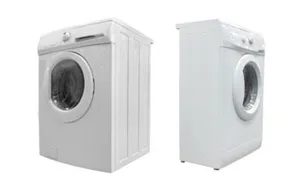
Front-load machines resemble the heavy-duty units you see in laundromats. They generally use the least amount of water. Because the drum tumbles clothes rather than agitating them aggressively, they are typically gentler on fabrics.
However, there are maintenance headaches. The rubber door seals on front loaders can fail. They also tend to develop a musty smell if they stay wet and closed continuously. You need to keep that seal dry and clean.
Top Loaders
High-efficiency top loaders have improved significantly. Models like the Maytag Bravos feature specially designed agitators and stainless steel baskets that are gentle on clothes.
Price is a major factor here. Top loaders are often cheaper than front-loaders. A conventional top loader might cost less than $300. But a high-end HE top loader, like the Maytag Bravos, runs around $900. This puts it in the same price range as top-rated HE front-loaders.
In terms of efficiency, HE top-loaders generally use more water than front-loaders, but they are still far superior to old models. Front-loaders usually win on pure energy efficiency, but the gap is narrowing.
The Detergent Rule
You cannot use just any soap in these machines. Low-water HE washing machines require special detergents.
- Look for the HE logo.
- Stick to liquid. Powder detergents do not dissolve properly in the low-water environment of an HE machine and can cause damage or poor cleaning results.
The good news? HE detergents are comparable in price to standard detergents. You don’t need to pay a premium for the soap.
Is It Worth the Investment?
Yes, but look at the long term. You will pay more upfront for an Energy Star-certified low-water washing machine. However, the savings add up.
A low-water Energy Star machine can save a family up to $30 a year in water costs. Over a 10-year lifespan, that’s $300 saved just on water. Add in the energy savings—roughly $25 per month on your electric bill—and you’re looking at about $55 in total monthly savings.
Beyond the math, there is the resource argument. Conserving natural water resources is a tangible benefit. If you’re a DIY homeowner looking to update your utility space, choosing an efficient washer is a practical move that pays for itself.
The market is shifting. The question is no longer whether you should switch, but which style fits your laundry routine best. Front-loaders offer maximum efficiency and fabric care, but demand more maintenance. Top-loaders offer convenience and a wider price range, with HE models now offering respectable performance.
Your water bill is waiting.