
Before the 1930s, homeownership was a luxury reserved for the wealthy. Only 40% of American families owned their homes because cash purchases were the only option. There were no bank loans for buying houses. That changed when the mortgage system emerged. Today, that same system feels complicated and risky to many buyers.
A mortgage is simply a loan secured by your house. The bank gives you 80% of the home’s price. You pay it back with interest over time. If you miss payments, the lender takes the house. This legal process is called foreclosure.
Зміст
Fixed vs. Adjustable Rate Mortgages (ARMs)
For decades, fixed-rate loans were the only real choice. You got one interest rate for 30 years. Payments stayed steady. Then came adjustable rate mortgages or ARMs in the 1980s. These started with lower rates. They reset every year.
During the recent housing boom, lenders got aggressive. They offered “creative” ARMs. These had short reset periods. Teaser rates lured in borrowers. There were no limits on how high the rate could jump. When the economy tanked, foreclosures followed. Since 2007, over 250,000 Americans entered foreclosure each month. By 2010, repossessions hit 1 million homes.
Many borrowers didn’t understand what they signed. One study found that 35% of ARM borrowers didn’t know if their rate had a cap. That’s dangerous. You need to know your terms.
How Mortgages Work Legally
Legally, a mortgage pledges property as security for a debt. In plain English, it’s a loan. It’s usually the biggest loan you’ll ever take.
Regular loans check your credit and income. They don’t have collateral. Mortgages use the house itself as collateral. No payments? The lender takes the house.
Banks are traditional lenders. You can apply at your local bank. Or shop around for better rates. Want help? A mortgage broker can search lenders for you. Banks aren’t the only source though. Credit unions, pension funds, and government agencies also offer these loans.
Mortgages have interest rates. They have terms. Terms range from five to 30 years. Fees are heavier here than elsewhere. Some fees are one-time. Closing costs are the main example. Others happen monthly. You pay them with your payment.
“Understanding the terms of your mortgage is essential, particularly the pitfalls of nontraditional loans.”
Why Knowledge Matters
The housing crash showed us what happens when people guess. They signed documents they didn’t read. They ignored reset clauses. They failed to see rate caps. The result was mass repossession.
We’ll break down every mortgage type. We’ll explain escrow. We’ll define amortization. We’ll list hidden costs. We’ll start with the basics. What is a mortgage really? It’s a promise backed by your roof. Keep that promise. Know the rules.
This isn’t just theory. It’s your equity. Your shelter. Your biggest asset. Treat it like one.
You might assume mortgages have been a constant since the first human built a shelter. It seems logical. How else could anyone afford a place to live?
The reality is messier.
Modern mortgages as we know them didn’t exist until the 1930s. And surprisingly, banks weren’t the pioneers. Insurance companies started the trend. Their motive wasn’t altruistic. They wanted to acquire properties when borrowers defaulted. It was a strategy to gain real estate assets.
Then came the Federal Housing Administration (FHA).
The FHA’s Role in Modern Mortgages
In 1934, the Great Depression was still choking the economy. Only four in ten households owned homes. The existing lending system was broken.
Loan terms were brutal.
Lenders capped loans at 50 percent of the property’s market value. Repayment schedules were short. Three to five years. And the end of that term featured a balloon payment.
If you financed 80 percent of the home’s value back then, your down payment was actually 80 percent. You borrowed only 20 percent. That’s backward from today.
This structure forced most Americans to remain renters.
The FHA changed everything.
They lowered down payment requirements. They introduced loan-to-value (LTV) ratios of 80 percent, 90 percent, and higher. This forced commercial banks to adapt. Average Americans suddenly had a path to ownership.
The FHA also changed how lenders qualified borrowers.
Before, it was often about who you knew. The FHA required proof of actual ability to repay. They extended loan terms. Five to seven years became 15. Then 30.
Construction quality became a factor too. The FHA set standards for home construction. Loans wouldn’t be issued for structures that might crumble before the loan was paid off. Commercial lenders followed suit.
The biggest shift was amortization.
Traditional mortgages required interest-only payments. At the end, you paid the entire principal. Foreclosures were common because people couldn’t handle the balloon payment.
Amortization meant paying down principal with every payment. The loan balance decreased gradually. You paid off the entire debt over time.
Breaking Down Your Monthly Mortgage Payment
Understanding the mortgage payment structure is essential for any homeowner. It’s not just one number. It’s a bundle of costs.
Your down payment is the upfront cash. It reduces the borrowed amount. You can put down as much as you want. The traditional benchmark is 20 percent. Some loans require as little as 3 to 5 percent.
More money down means less to finance. It also lowers your monthly bill.
The monthly payment is usually tracked by the acronym PITI.
- Principal : The total amount borrowed.
- Interest : The cost of borrowing. A percentage of the loan amount.
- Taxes : Property taxes. Often held in an escrow account by the lender until due.
- Insurance : Hazard insurance protects against fire, storms, theft, and floods. If you have less than 20 percent equity, you may also need private mortgage insurance (PMI).
How Amortization Actually Works
With a fixed-rate mortgage, your total monthly payment stays roughly the same. The split between principal and interest changes every month.
This gradual repayment is amortization.
Look at a typical 30-year amortization schedule.
In the early years, you pay mostly interest.
Consider a $100,000 loan at 6 percent. The monthly payment is $599.
In year one, about $500 goes to interest. Only $99 reduces the principal.
It takes until year 18 for the principal payment to exceed the interest payment.
This has pros and cons.
The advantage is manageable monthly payments. You don’t face a massive lump sum at the end.
The downside is the total cost. You end up paying $215,838 for that original $100,000 loan. It takes longer to build equity.
Equity is your home’s value minus the remaining loan balance.
Does this mean 30-year fixed mortgages are bad?
Not at all. We’ll look closer at them next.
Fixed-Rate Mortgage Stability vs. ARM Volatility
For decades, the 30-year fixed-rate mortgage was the only game in town. It offers a simple promise: the interest rate never changes. Neither does your principal and interest payment. That stability lasts for 15, 20, or 30 years. The only variables are your property taxes and insurance premiums. These can shift based on local assessments or market rates.
But the rate you lock in depends on the broader economy. In a growing economy, rates climb. During a recession, they drop. Lenders adjust these baseline rates based on your credit score and loan length.
Here is how the terms break down if you choose stability.
The 30-Year Fixed-Rate Mortgage
This is the standard for a reason. It offers the lowest possible monthly payment. That frees up cash flow. However, you pay the most interest over the life of the loan. There is a silver lining. You can deduct that interest from your taxes. If you plan to stay in the home for a decade or more, this long-term lock-in is often worth the total cost.
The 20-Year Fixed-Rate Mortgage
These are harder to find. But the shorter term forces faster equity building. Your monthly payments are higher than the 30-year option. In exchange, the interest rate is usually lower. You pay less interest overall. You own the home sooner.
The 15-Year Fixed-Rate Mortgage
This is the fastest path to ownership. It shares the benefits of the 20-year loan. Faster payoff. Higher equity. Lower rate. But the monthly payment is even steeper. You need serious income to make this work without stretching your budget.
Fixed-rate mortgages provide long-term stability that attracts borrowers planning to stay put.
Why Choose an Adjustable-Rate Mortgage?
An adjustable-rate mortgage (ARM) works differently. The rate changes. Usually annually. It tracks market conditions. Your monthly payment follows suit.
Why would anyone sign up for that? Because the starting rate is lower. Often significantly lower. Even when 30-year fixed rates were near historic lows in 2010, ARM rates were almost a full percentage point cheaper.
ARMs also make sense for people who know they will move. If you plan to sell within a few years, you can enjoy the low initial rate before it adjusts.
But intentions often fail. During the real estate boom, many borrowers thought they would sell quickly. They got stuck. They faced a “reset” rate they couldn’t afford. They didn’t read the fine print.
If you are considering an ARM, you must understand the mechanics.
How Often Does It Adjust?
A conventional ARM adjusts every year. But there are variations. You can find six-month ARMs. One-year ARMs. Two-year ARMs.
Hybrid ARMs are popular. Consider the 5/1 year ARM. It holds a fixed rate for five years. Then it adjusts annually for the rest of the loan. Or look at the 3/3 year ARM. Fixed for three years. Then adjusts every three years.
What Are the Caps?
Caps are limits. They protect you. They dictate how much the rate can rise.
* Interim caps limit the rise per adjustment.
* Lifetime caps limit the total rise over the loan’s life.
Never sign an ARM without caps. Without them, your payment could skyrocket.
How Is the Rate Determined?
ARM rates tie to indexes. These might be one-year U.S. Treasury bills. Certificates of deposit. The London Inter-Bank Offer Rate (LIBOR). Lenders take that index and add a margin. Usually two to four percentage points.
When the index goes up, your rate goes up. But there is a catch. When interest rates drop, your ARM rate might not. The margin stays fixed. The index moves. Read the contract.
Now let’s look at some of the less common mortgage options, like government-sponsored loans, balloon mortgages and reverse mortgages.
Beyond the Standard 30-Year Loan
Most people think about mortgages in black and white. Fixed. Adjustable. You know the drill. But the market is messier.
Consider the balloon mortgage. It’s short-term, usually five to seven years. But it’s amortized like a 30-year loan. Your monthly payments look tiny. Comfortable, even.
Then the balloon hits.
At the end of the term, you owe the entire remaining principal. We’re talking close to the original loan amount. If you can’t sell the house or refinance instantly, you’re stuck. It’s a high-wire act with no safety net.
Then there are reverse mortgages. Designed for homeowners 62 and older. The bank pays you. Monthly checks. Or a line of credit. You borrow against equity.
No payments due. As long as you stay. You don’t have to pay back the loan until you sell, move, or pass away.
But the catch? Closing costs are steep. And you still owe property taxes and mortgage insurance. It’s not free money. It’s borrowed time.
Government-Backed Options Explained
Three federal agencies back these loans. They don’t lend the money themselves. They insure it.
This shifts the risk from the bank to the government. If you default? The government covers the loss. That’s why they offer better terms.
Federal Housing Administration (FHA)
Run by HUD. Great for bad credit. The lender knows the government will bail them out.
– Down payment: Just 3 percent.
– Source: Can come from family, employers, or charities.
Veterans Administration (VA)
For qualified veterans.
– No money down.
– Relaxed credit requirements.
– Subject to county loan limits.
Rural Housing Service (RHS)
Part of the USDA. For rural and small-town buyers.
– Low-interest rates.
– Guaranteed loans through private lenders.
– Direct government-funded loans for low-income families.
Decoding APR vs. Interest Rate
Interest rates lie.
Well, not exactly. They just don’t tell the whole story. Comparing a 7 percent rate on one loan to a 6 percent rate on another? You’re missing the point. Literally.
The Truth in Lending Act forces lenders to disclose the Annual Percentage Rate (APR).
Why? Because the interest rate ignores fees. Origination fees. Points. PMI. Closing costs.
APR includes them all.
It’s the average annual finance charge divided by the amount borrowed. Expressed as a percentage. It’s always higher than the note rate.
Here’s the trap.
You see two ads.
Lender A: 7 percent fixed. One point.
Lender B: 7 percent fixed. Zero points.
Easy choice? Maybe not.
Let’s run the numbers.
Loan amount: $100,000.
Monthly payment: $665.30.
Lender A charges one point. That’s $1,000.
Plus $25 application fee.
$250 processing fee.
$750 in other closing costs.
Total fees: $2,025.
The lender deducts this from the loan. You get $97,975 in hand. But you pay interest on the full $100,000.
To find the true cost, you calculate the rate that equates a $665.30 payment on a $97,975 loan.
The APR jumps to 7.2 percent.
Lender B might look cheaper upfront. But Lender A’s APR tells the real story.
Does a lower fee always win? Not necessarily. Keep reading. The relationship between APR and origination fees is tricky.
Lenders don’t give loans away for free. They need an upfront cut, and that’s where the origination fee comes in. It’s the kickback they take just to process your paperwork. Usually, it sits between 0.5 and 1 percent of the total loan amount on U.S. mortgages. But it can be higher.
Let’s look at a real-world scenario to see why the advertised rate is often a lie. Imagine Lender B claims zero discount points. Sounds great, right? Wrong. They charge a massive 3 percent origination fee. Add in application costs and other closing line items totaling $3,820, and the actual cash you receive shrinks. If your loan was supposed to be $100,000, you only walk away with $96,180. The lender still charges interest on a smaller stack of cash, but the APR calculation reflects that loss. The result? A 7.39 percent APR. The first lender might have looked cheaper upfront, but this one just cost you more in hidden fees.
Don’t be fooled by the headline interest rate. It’s a marketing tool. Look at the Annual Percentage Rate (APR). It’s the only number that tells the truth about the total cost of borrowing.
What Goes Into the APR Calculation?
The APR isn’t just interest. It’s a grab bag of fees bundled into one percentage. To compare lenders fairly, you need to know what’s inside that bag. Most of these costs are non-negotiable, meaning you can’t haggle them down.
Typical inclusions in the APR figure are:
- Origination fees
- Discount points
- Buydown fees
- Prepaid mortgage interest
- Mortgage insurance premiums (if applicable)
- Application fees
- Underwriting costs
Some costs are flat fees charged by third parties, like title insurance and home appraisals. These are part of closing costs but don’t always impact the APR in the same way as the lender’s own fees. The key is asking for a breakdown. You don’t have to do the math yourself. The lender is legally required to provide the Federal Truth in Lending Disclosure. This document spells out the APR. Your job is to read it, not just sign it.
Why Loan Size and Timeline Matter
The impact of these fees changes depending on how much you borrow and how long you stay.
The larger the loan, the less those fixed fees bite into your APR. If you’re borrowing $500,000, a $2,000 closing cost is a rounding error. If you’re borrowing $200,000, that same $2,000 is a significant chunk of your equity.
Then there is the timeline. Mortgages are 30-year products, but few people live in their homes for 30 years. If you pay discount points to lower your rate, you’re betting on long-term ownership. Pay for points upfront to save on monthly payments? That’s a break-even analysis.
If you refinance or sell after three years, those upfront points might cost you more than the monthly savings would have. You never get them back. Your effective interest rate skyrockets because you paid for a discount on a loan you
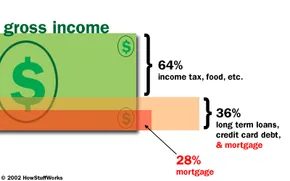

Lenders are looking at one number above all else: your debt-to-income ratio (DTI). Most want to see a debt-to-income ratio of 28/36. That’s a shorthand for two limits. No more than 28 percent of your gross monthly income goes toward housing costs. No more than 36 percent goes toward all monthly debt obligations combined.
This includes the mortgage you’re asking for plus car loans, student loans, credit card minimums, and any other long-term debts. The rules can shift slightly based on your down payment size or loan type, but the 28/36 benchmark remains the industry standard for qualifying.
How Your Monthly Income Limits Your Mortgage
Let’s break down the math so you aren’t guessing. Suppose you earn $35,000 a year. That breaks down to about $2,916 in gross monthly income.
If you are looking at a house with an $800 monthly mortgage payment, you are safe on the housing front. $800 is roughly 27 percent of that $2,916. It sits under the 28 percent cap.
But what happens when you add in your other debts? Say you have a $200 car payment and a $115 student loan. Those are $315 in added monthly obligations.
Add that to the $800 mortgage. Your total monthly debt is $1,115. Now, $1,115 is roughly 38 percent of your gross income.
Your ratio looks like 27/38. The housing part is fine. The total debt part is not. Lenders typically use the lesser of the two numbers to determine your qualification limit—in this case, the 28 percent housing limit. Since your total debt exceeds 36 percent, you might be denied or forced to provide a larger down payment to lower the monthly mortgage balance.
Why Lender Approval Doesn’t Mean You Can Afford It
Here is where DIY homeowners often get burned. The lender tells you what you qualify for. They do not tell you what you can afford.
Their calculation ignores your grocery bill. It ignores your gas. It ignores that expensive hobby you’ve been planning to drop by next year. It doesn’t know if you are saving for a renovation or a new car in five years.
A lender might say you qualify for a $1,400 mortgage payment. That number feels real. But if your actual budget only allows for $1,200 after food and utilities, you are living on borrowed time. Especially if your income isn’t set to jump significantly in the next few years.
Use a mortgage affordability calculator. Run the numbers yourself. Do not rely on the lender’s “qualification” letter as a green light to spend every last dollar of your approved loan amount.
The Current Credit Market Reality
Qualifying for a mortgage is harder now than it was during the housing boom. Back then, motivated buyers could often find credit regardless of their financial health. That era is over.
The credit market has been tight for years. Lenders reserve their best interest rates for borrowers who look like the safest bets. That means high credit scores, typically between 760 and 850. It also means a substantial down payment, often 10 to 20 percent of the purchase price.
If you lack stability, you might still get a loan, but the cost will be higher. You may need to shop around more aggressively or accept a higher interest rate to offset the risk.
Employment and Income Verification
Lenders need proof of stability. They will scrutinize your employment history and credit report to gauge the likelihood of repayment.
Employment History
They want to see steady employment with a single employer for the past two years. Being in the same field for two years is usually acceptable if you changed jobs. If you have income from part-time work, overtime, bonuses, or self-employment, it counts. But it must have a documented two-year history. If you don’t meet these minimums, you aren’t out of luck. You might just need to talk to more lenders or expect less favorable terms.
Credit History
Stability in payments is key. Lenders look closely at the last two years of your credit history. They pay particular attention to any rent or mortgage payments that were more than 30 days late. They also scrutinize late credit card payments from the last six months. A pattern of missed payments is a red flag that can derail your application.
Documents You Need for a Mortgage Application
You cannot wing this part. The lender will require a specific stack of paperwork. Having these ready speeds up the process and keeps you from missing a deadline.
Here is the typical checklist:
- Closing Cost Funds : Proof of money available for closing costs.
- Sales Contract : The completed contract signed by both buyers and sellers.
- Social Security Numbers : For all applicants.
- Address History : Complete addresses for the past two years, including landlord names and addresses for any rentals.
- Employment Records : Names, addresses, and all income earned from employers for the past 24 months.
- W-2 Forms : For the two years prior to your application.
- Pay Stubs : Your most recent stub showing year-to-date earnings.
- Debt Details : Names, addresses, account numbers, monthly payments, and current balances for all loans and charge accounts.
- Asset Statements : Names, addresses, account numbers, and balances for all deposit accounts, checking, savings, stocks, and bonds.
- Recent Statements : The last three statements for all deposit accounts, stocks, and bonds.
- Support Income : If you rely on child support or alimony, bring court records and cancelled checks showing receipt of payment.
A more detailed list is available through your lender or closing attorney. They will also specify what paperwork is needed at the actual loan closing. We will cover that final step in the next section.
Prequalification vs. Preapproval: Knowing the Difference
These terms are often used interchangeably, but they mean two very different things in the homebuying process.
Prequalification is a loose estimate. You tell a lender your income, debt, and credit info. They give you a rough idea of what you might afford. No heavy lifting is done.
Preapproval is a serious commitment. The lender pulls your credit report. They verify your income. They check your DTI ratio with actual data. They do the legwork.
Getting preapproved puts you much closer to the actual loan. It shows sellers you are a serious buyer. It also protects you from surprises. If you haven’t checked your own credit report, getting preapproved first lets the lender find any errors or issues before you fall in love with a house.
Read more about how these steps impact your buying power.
You think you’re just paying for the house. You’re wrong. The total cost of owning a home includes a lot more than your monthly mortgage payment. Once you sign that sales contract, the clock starts on the closing process.
This isn’t just paperwork. It’s a legal transfer. The deed moves to your name. Title insurance gets issued. Financing documents get stamped and sent to the county recorder. Because this is a legal event, you usually need an attorney or a third-party escrow holder to watch the wheels turn. And watching wheels turn costs money. A lot of it.
These fees add up to what we call closing costs. They are real. They are substantial. And they vary wildly depending on where you live.
Why closing costs vary so much
If you live in a high-tax area, your costs go up. Simple as that. Realtors, lenders, and attorneys have different fee scales in different markets. Don’t expect uniform pricing.
Typically, you will pay between 3 and 6 percent of your total loan amount in closing costs. Let’s do the math. If you have a $100,000 loan, you’re looking at $3,000 to $6,000 in extra fees. Just to close the deal.
You can fight this. You should fight this.
The Real Estate Settlement Procedures Act (RESPA) is on your side. Lenders must give you a good faith estimate of these costs within three days of receiving your application. Read that document. Look for fees you can talk down. You can negotiate with the lender. You can ask the seller to pay some of them. Do the work.
The three buckets of fees
To understand what you’re paying for, group the fees into three categories.
- The actual cost of getting the loan.
- The fees for transferring ownership of the property.
- Taxes paid to state and local governments.
We’re breaking down the first bucket now. These are the fees lenders charge to get your money to you.
Processing and appraisal fees
Start with the processing fee. This covers the initial legwork. The application. The credit report access. Usually, this runs $400 to $550. Watch out for hidden splits. Sometimes the lender lists the credit report fee separately from the processing fee. It’s the same cost, just listed twice. Compare lenders carefully.
Next is the appraisal. The lender needs to know the property is worth what you’re paying. They send in an independent appraiser. This person compares your home to similar properties in the neighborhood. It costs around $250 or more, depending on the price of the house.
“An appraisal compares the value of the property to similar properties in the same neighborhood.”
Origination and discount points
Lenders often charge an origination fee. This is separate from the processing fee. It covers the extra work of preparing your mortgage. It can be a flat fee. Or a percentage of the mortgage.
Be careful with the percentage version. If they charge by percentage, it’s often a “discount point” in disguise. This changes your tax implications. It changes your total cost. Ask the lender exactly what this fee is. Don’t assume.
This leads to discount points. Buying points means you’re buying down your interest rate. One point equals one percent of the loan amount. You pay this when the loan is approved or at closing.
Does it make sense? Often, yes. Buying points can save you thousands in interest over the life of the loan. Shop around. See which lenders offer points. Some let you add the cost to your mortgage. Others want it paid upfront. You can also deduct these points from your federal income tax. Check the rules.
Document preparation costs
Finally, there is the document preparation fee. This covers the mountain of paperwork. The lender, the attorney, or the escrow company charges this. It pays for the labor of creating and organizing all those legal forms.
Usually, it’s a flat rate. Sometimes it’s a percentage of the loan amount. That percentage is typically less than one percent. It might be included in your application fee or your attorney’s fee. If it’s listed separately, make sure it’s not double-billing you.
These are just the start. There are more fees. More tricks. More places to save money if you know where to look.
Legal and Inspection Realities
Attorney fees aren’t just a suggestion. Both you and your lender will pay them. Your lawyer draws up the documents. They set up the closing properly. You need representation. Your closing attorney protects your interests. They might be at the table. Or they might facilitate it remotely.
The process is specific. The attorney collects fees. They transfer the deed to you. They pay your outstanding taxes and utility bills. They pay themselves. They pay other closing costs. Everything else goes to the seller.
Expect attorney fees to land between $500 and $1,000 or more. The price depends on the property value. It also depends on how messy the sale is. Complexity costs money.
Inspections are non-negotiable. Your lender will require a home inspection. They need proof the structure is sound. They need proof there are no termites. Destructive insects matter.
If your property uses a well, you must test the water. City tap water doesn’t need this. Well water does. Sometimes the test is just about quantity. It checks if there is enough water to reach the house. Quality might be ignored.
Don’t skip the quality check. If the lender only checks quantity, hire your own test. You are living in the house. Drink the water. Test the quality yourself.
Insurance is mandatory. You need homeowner’s insurance. You need hazard insurance. Most states require these policies at closing. You must prepay the first year’s premium. This protects your investment. It protects the lender’s too. If the house burns down, the money is there.
The Cost of Ownership and Security
Private mortgage insurance (PMI) is a trap if you aren’t careful. If your down payment is less than 20 percent of the home’s value, you trigger PMI. This protects the lender. It covers them if you default on payments.
The premiums are added to your monthly mortgage. They go into the same escrow account. Your taxes and insurance payments swim in that pool too. You pay these premiums until you hit 20 or 25 percent equity.
Sometimes they stick around. They can last the life of the loan. Don’t assume they vanish automatically. Read the fine print.
Surveys are another lender requirement. Many lenders demand an independent land survey. Why? To check for changes. New structures. Encroachments. Did the neighbor build a fence over the property line since the last survey?
These surveys cost $250 to $500. It’s a small price to avoid a fence dispute with your neighbor.
Timing, Title, and Tax Traps
Prepaid interest is a sneaky cost. Your first mortgage payment isn’t due for six to eight weeks. But interest starts accruing the day you close. The lender calculates the interest for that fractional month. You pay it upfront.
Time your closing strategically. Aim for the end of the month. This reduces the prepaid interest you owe. A few days difference can save hundreds. Don’t leave money on the table.
Deed recording fees are straightforward. They usually cost around $50. This pays the county clerk. They record the deed. They record the mortgage. They update billing information for property taxes. Without this, you don’t legally own the home.
Title searches are critical. A title company examines public records. They look at deeds. Death records. Court judgments. Liens. Contest over wills. Anything that affects ownership rights.
This step ensures no one else has a claim. Fees range from $300 to $600. They are often based on a percentage of the property cost. Don’t skip this. A bad title can cost you the house.
Title insurance backs up the search. If the title company misses something, you are covered. Title insurance protects you from paying a mortgage on a home you don’t legally own.
Lenders require it. You should get your own policy too. It’s a one-time fee. It covers the property for as long as you or your heirs own it.
Lender’s title insurance costs 0.2 to 0.5 percent of the loan amount. Owner’s title insurance costs 0.3 to 0.6 percent. It is one of the least expensive insurance types.
If the previous owner held the title for only a few years, ask for a “re-issue” rate. It is usually lower than the regular rate. Save where you can.
Closing taxes vary by state. You might pay three to eight months’ taxes upfront. Or you place money in an escrow account. These include prorated school taxes. Municipal taxes. Other required levies.
Negotiate if possible. In some cases, you can split taxes with the seller. You pay for the months after closing. The seller pays for the months before closing. The split point is the closing date. It’s fair. It’s standard. But you have to ask.
The bill keeps coming. Even after you close, there’s more.
How PMI Lets You Buy With Less Cash Down
Private mortgage insurance (PMI) is the bridge for buyers who don’t have twenty percent saved up. It’s not free money. It’s insurance for the lender, who is nervous about handing out a loan when you have so little skin in the game. There is data. Real data. Showing that people who put more money down are less likely to walk away. Less risk for the bank means they will write the check.
Think of it this way. You have ten thousand dollars. Without PMI, you can only buy a fifty thousand dollar house. With PMI, that same cash gets you into a hundred thousand dollar home. Or maybe two hundred grand. You get more house. But you pay for the privilege. The cost scales with the loan size. For a hundred thousand dollar loan with ten percent down, expect to pay roughly forty dollars a month. It adds up. But you are building equity faster than if you rented.
When Can You Cancel PMI?
The government stepped in to stop lenders from keeping that money forever. The Homeowners Protection Act of 1998 set the rules. If you signed your mortgage after July 29, 1999, things are clearer. The law mandates automatic cancellation once you hit twenty-two percent equity based on the original value. You don’t even have to ask.
You can also ask for it earlier. Hit twenty percent? Request removal. But there is a catch. This only applies to loans signed after that 1999 deadline. If your loan is older, you can still request cancellation at twenty percent equity. The lender isn’t legally forced to say yes. They might drag their feet.
Some states have their own early termination laws for pre-1998 loans. Check your local statutes.
There are exceptions to the rule. If you are late on payments, the clock stops. If the loan is flagged as high-risk, PMI stays. Other liens on the property can block cancellation too. Keep your payments current. That is the easiest way to get rid of the extra cost.
The Real Players: Fannie and Freddie
Lenders don’t make their real money from interest. They make it by selling. If a bank waited thirty years to get paid back, it would run out of cash to lend to anyone else. They need liquidity. Now.
So they sell the mortgages. On the secondary market.
The big buyers are government-sponsored enterprises (GSEs). Fannie Mae and Freddie Mac. They were created by Congress to make housing accessible for low and moderate income families. They buy mortgages from local banks. Then they package them into mortgage-backed securities (MBS). They sell these packages to investors in the bond market.
This system worked. Until it didn’t.
For a mortgage to be bought by Fannie or Freddie, it has to meet strict limits. In 2010, that limit was $417,000 for a standard single-family home in most areas. High-cost areas like parts of Hawaii could go up to $1.8 million. If your loan was bigger, you needed a jumbo loan. No GSE support.
The MBS sold by Fannie and Freddie were considered solid. Safe. Until hundreds of thousands of borrowers defaulted. The value of those securities crashed. International banks had bet big on them. The shockwaves hit the global economy hard.
Bailouts and Survival
In 2008, the government had to step in. The Federal Housing Finance Agency took over Fannie and Freddie. Technically, they entered “conservatorship.” The U.S. Treasury pumped $145 billion into them by June 2010. Emergency liquidity. Without that money, the credit market might have frozen completely.
They were still public companies after the takeover. Until their stock price dropped below the minimum requirements for the New York Stock Exchange. They were delisted in 2010.
Despite the trauma of the crisis, they remain the largest purchasers of mortgages. They are essential. The system relies on them to keep the money flowing. Even if you don’t trust them.
Foreclosure is the next topic. And how the government tries to help borrowers avoid total financial ruin. But that’s a different battle.
Understanding the Foreclosure Process
Missing payments doesn’t mean you lose your house overnight. Foreclosure is the legal mechanism lenders use to repossess your property and sell it to recoup their losses. The scale of the 2008 crisis remains unmatched. Lenders filed 2 million proceedings in that single year. One million borrowers lost their homes. By 2010, analysts predicted up to 4 million households might receive notice.
Receiving notice isn’t a death sentence. It is a warning shot.
Government Programs to Avoid Foreclosure
Federal initiatives aim to keep you in your home and protect your credit score. Visit MakingHomeAffordable.gov to check eligibility for four specific pathways.
Home Affordable Refinancing Program
This option targets borrowers who have stayed current on payments until recently. If your property value has plummeted, this program allows you to refinance at a lower interest rate. It is designed for those who are still solvent but need a payment adjustment to stay afloat.
Home Affordable Modification Program
If your mortgage payment exceeds 31% of your gross monthly income, you may qualify. The government steps in to negotiate with your lender. This is crucial if you have faced significant hardship. Job loss. Medical emergencies. These events trigger the ability to secure a new, affordable payment plan.
Second Lien Modification Program
Many homeowners hold both first and second mortgages. When the first loan becomes unmanageable, the second one often follows. This program incentivizes lenders to forgive second liens or slash interest rates to 1 percent. It reduces the total debt burden significantly.
Home Affordable Foreclosure Alternatives
If refinancing or modification is off the table, there are still exit strategies. The government encourages lenders to approve a short sale. The home sells for less than the owed amount. The lender takes the loss, but you avoid the full foreclosure stain. Alternatively, you can offer a deed in lieu of foreclosure. You voluntarily transfer the title to the bank. You walk away owing no remainder. In either scenario, the government provides up to $3,000 for relocation costs.
Why Lenders Prefer Alternatives
Foreclosure is expensive for banks too. The Mortgage Bankers Association estimates processing a single claim costs over $50,000. Then the bank must sell the asset. These properties often sell for a fraction of the original loan value. It is a losing game for everyone involved.
Beware of Scams
Do not pay for mortgage counseling. Do not pay for loan modification services. The government explicitly warns that these are often scams. Help is available for free. Call the HOPE Hotline at 888-995-HOPE. The Housing and Urban Development office runs this toll-free line. It is the official resource for struggling homeowners.
If you need to lower your mortgage cost to stop the clock, look at refinancing options next.
The credit market doesn’t have to be a cage. You can still claw back money if you know where to push.
Negotiation is your first lever. Lenders often inflate fees that aren’t strictly regulated. Document preparation fees? Lender attorney fees? These are up for grabs. Real costs like appraisals, title work, and credit reports are fixed. But everything else is negotiable. If your credit score is solid, ask for waivers. Don’t assume the first quote is the final one.
Choosing your loan type is where most people lose money later.
A 30-year fixed-rate mortgage costs the most in total dollars over the life of the loan. It’s true. But stability has value. For decades, this was the gold standard for a reason. It doesn’t surprise you. An adjustable-rate mortgage (ARM) or a 5/1 hybrid might look cheaper today. But can you afford the payment when the rate resets? What if your income stalls? The 2008 crisis proved that a low initial rate doesn’t equal a good deal. Run the numbers. Stress-test your budget against worst-case scenarios.
Strategies to Pay Off Your Loan Faster
Making extra payments hits the principal directly. This is the key. Most of your monthly payment goes to interest in the early years. Redirecting extra cash to the principal cuts that interest short. One extra payment a year can shave nearly 10 years off a 30-year loan. The savings are real. Use a calculator to see the exact impact on your timeline.
Biweekly payments offer a sneaky way to achieve this.
Instead of one large monthly check, you pay half every two weeks. Since there are 52 weeks in a year, you make 26 half-payments. That equals 13 full payments. You get the extra payment without feeling the pinch of a lump sum. It aligns with many paycheck schedules. A 30-year fixed mortgage can be retired in about 23.5 years this way.
Avoiding Private Mortgage Insurance (PMI) is another direct win.
Aim for a 20% down payment. It’s a high bar, but it eliminates that monthly insurance cost. If you’ve already started with less than 20%, monitor your equity closely. Once you hit that 20% threshold, demand the cancellation of PMI. It’s often automatic at 22%, but don’t wait. Call the servicer.
Points are a different animal.
Buying points lowers your rate upfront. But does it save money? Not always. It depends on how long you stay in the home. Use a points calculator. Compare the upfront cost against the monthly savings. If you plan to sell in five years, buying points might cost you more than it saves. Make sure the recoup period fits your actual timeline.
Understanding Mortgage Mechanics
What exactly is a mortgage? It’s a loan secured by your house. The lender gives you the bulk of the purchase price. You pay it back with interest over time. If you default, they take the collateral.
Calculating your monthly payment is straightforward with online tools. Bankrate’s calculator is a reliable starting point. Your down payment size directly impacts the monthly number. Larger down payment equals lower monthly obligation. If you’re working with a broker, they can model unique factors specific to your profile.
Interest calculation is simple math, even if the compound effect feels complex. The lender takes your outstanding loan balance. They multiply it by your agreed annual rate. Then they divide by 12. That’s your monthly interest portion.
Determining qualification isn’t a guessing game.
Get pre-approved by a broker. They look at your debt-to-income ratio, credit score, and down payment size. These metrics dictate exactly how much you can borrow. Online estimators from Realtor.com offer a quick preview, but pre-approval is the real test.
Interest rates fluctuate. Currently, they sit near historic lows. A 30-year fixed rate around 3% is available. This stability is expected to hold for now. But rates depend on your personal credit profile. Shop around. The lowest advertised rate rarely goes to everyone.


