The TV dies. The internet box shines as the last sad light. silence.
Your first reaction may be to call a professional. Don’t. That emergency call-out fee is a rip-off and 90% of the time the problem is minor. It’s spring. You’re out there pressure-washing the patio while the dryer is running and the oven is preheating. The house is demanding more power than the grid can easily provide. The circuit breaker has tripped. This is not a crisis. It’s a feature.
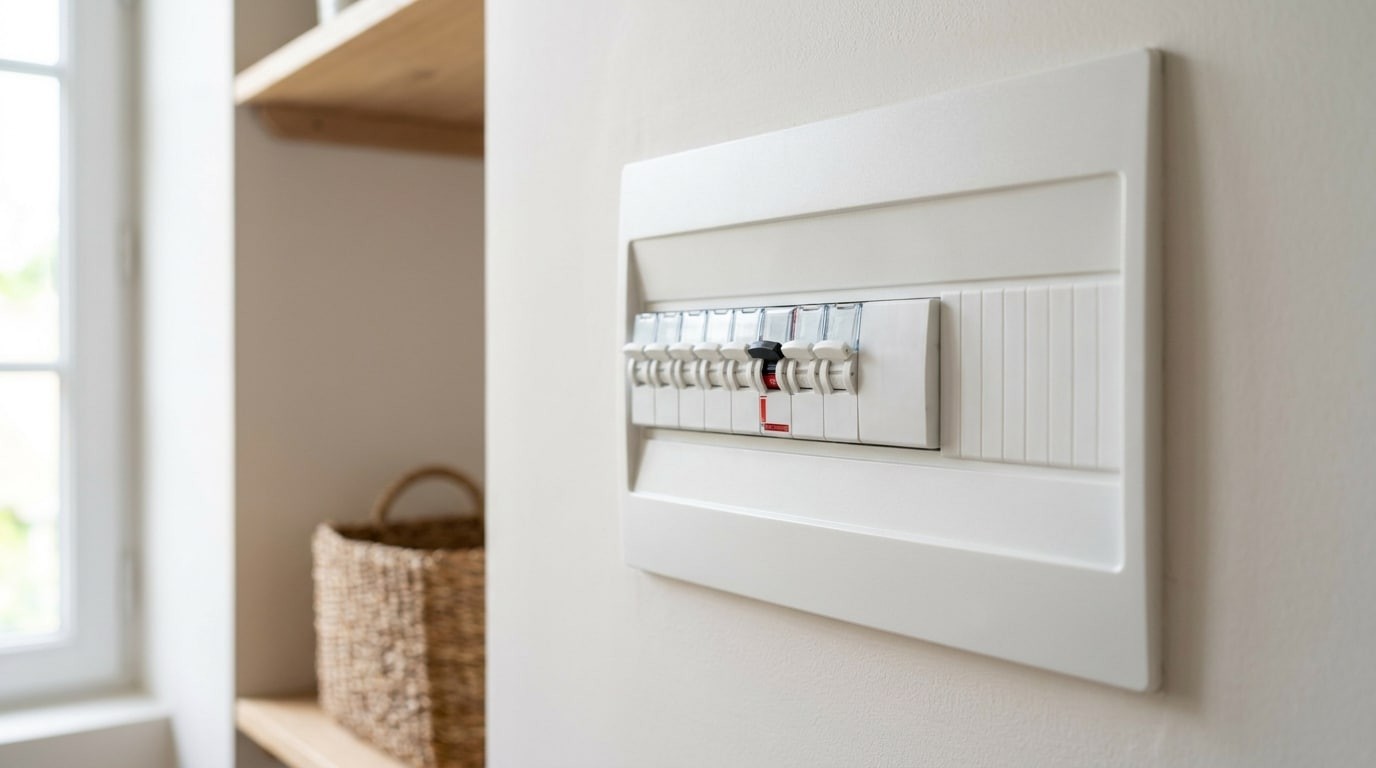
Don’t pay for a truck that never arrives. Start getting to know your home’s electrical panel. No engineering degree required. You just need to know how to play detective.
Зміст
Find the cause: overload and short circuit
If the circuit breaks, the panel will do what it was designed to do: protect your home from fire. Acts as protection. Your task is to find out why the shield fell.
Fix overload by reducing concurrent usage
The most common reason for a circuit breaker to trip is not damage. It’s too much demand.
You’re running the dishwasher, the microwave, and the space heater. The circuit can’t handle the amp load. The divisional breaker snaps to the “off” position.
Here’s how to fix it:
- Unplug one of your power consuming devices.
- Go to the panel.
- Flip the breaker handle back up.
When the power is restored, the overload is confirmed. The solution is not magic. it’s distribution. Stop plugging all your heavy hitters into the same circuit line. Spread the load. Use your washing machine on a different program than the oven. simple physics.
Test and isolate faulty devices one by one
Maybe it’s not too much power. Maybe the equipment is not good.
Is the heating element of your old toaster cracked? Is your vacuum cleaner cord frayed? These things break a circuit every time you plug them in.
You have to be organized. Patience is your tool.
- Unplug everything on the tripped circuit.
- Reset the circuit breaker.
- Reconnect the devices one at a time.
Look at the panel. Plugging in the problematic device will trip the breaker again. It’s your suspect. Remove it immediately. Fix it. Or throw it away. Don’t keep a fire hazard in your wall.
Look for invisible threats: short circuits and ground faults
Sometimes the problem is invisible. It’s hidden inside a wall. Or worse, in the moisture seeping into your outlets.
Look for burn marks to detect short circuits
Shorts are scary. It’s violent.
This happens when two wires are in direct contact. The insulation melts. Rodents chew the pipe. The current spike. Safety devices activate immediately to prevent electrical fires.
How do I know if there is a short circuit?
There is a smell of burning plastic.
Make sure there are no black burn marks around the outlet or switch.
*Note that the circuit breaker does not turn on even though “nothing is connected”.
If the circuit breaker does not work and the panel is empty, the fault is in the wall. Inspect the nearest boxes. Stop if you see any damage. You’re dealing with internal wiring issues now.
Check for ground faults caused by moisture.
The main panel has a differential circuit breaker. It does more than just protect your wires. they protect people. They stop electrocution.
If these trip, it’s usually a ground fault.
Current is leaking. It’s finding a path to the ground it shouldn’t take. Usually, this is done through the metal case of the device. But is it more common in spring? This is water.
Giboulées. Rain. Garden irrigation.
Water turns the socket into a conductor. Moisture can cause bridges to form if the external outlets are not closed properly or if the bathroom furniture is located near the bathtub. The circuit breaker trips to prevent electric shock.
Check the external points. Check the outlet in the bathroom. Dry them out. Repair the seal.
Why do-it-yourself diagnostics is important
The average homeowner spends hundreds of dollars to hire an electrician to fix problems that can be fixed by resetting switches and plugging in appliances. Information is cheap. Ignorance is expensive.
Start with the circuit breaker. Move to the appliances. Finally, look for hidden damage.
Power can be restored. Or maybe not. If you’ve isolated everything and the breaker still trips, call a professional. But you’ll know why. You will notice that this is not just a “quick fix”.
This is a symptom.
Fix the root. Leave the lights on.
Tighten any loose parts that cause the circuit breaker to trip
You checked the water. Noise caused by electrical equipment. So why is there still no power? The problem may be mechanical. This is a physical connection.
Wires expand and contracts when exposed to heat. Every time you flip a switch, a small change occurs. After years of use, the small screws on the main panel or behind the wall outlet can become loose. This is natural wear and tear. Create an arc. A little spark. Heat builds up. The circuit breaker tripped to prevent the house from burning down.
Don’t forget about safety. Kill the main power first.
Take an insulated screwdriver. Go to the panel. Check every accessible terminal. Tighten them down. Hard pressure is important. If the connection is tight, there is no heat source. In many cases, this is enough to restore power without the help of a professional.
Is your circuit breaker old and tired?
Electronic parts have an expiration date. A breaker looks tough. A spring mechanism is built inside. It works hard every time there is a power cut. Finally, that spring gets tired. It loses its elasticity.
If a particular breaker trips randomly (even when the circuit is empty and working properly), you may be in a worn out circuit breaker replacement situation.
The correction is standard, but precise. You must replace the product with the exact same amperage. Check the label. Is it 15 amps? 20? 30? An exact match.
- Turn off the main breaker.
- Remove the old unit.
- Install a new one.
- Turn the main back on.
This is not magic. This is maintenance.
Safe Power Restoration Checklist
Don’t guess. Follow the instructions. This systematic approach can prevent the problem from getting worse.
- Locate the trip: Which switch is down?
- Load isolation: Unplug everything from this circuit.
- Reset the circuit breaker: Turn the circuit breaker off, then turn it back on.
- Test individually: Plug in one device. Look at the panel. repeat.
- Visual inspection: Check for scorch marks or moisture near the outlet.
This process saves costs. It saves time. But it also gives you something else. control.
There’s a special sense of satisfaction when you know exactly why the lights went out in walking through your home. you fixed it. You understood the system?
The house behaves differently than expected. This is a machine. It wears out. It needs care. When you listen to it, you can usually tell what the problem is. All you have to do is turning the right screw.