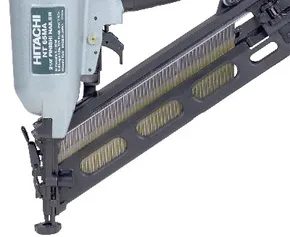
Most modern nailers rely on a strip of nails glued loosely together. This strip slides into the magazine and feeds into the barrel. Springs at the base push the coil forward. When you pull the trigger, the hammer drops. It separates the first nail from the strip. The nail flies into the wood.
The glue plays a hidden role. Friction heats the adhesive as the nail penetrates. The glue melts briefly. Then it cools. It hardens again. This fuses the nail to the wood. You get a tighter hold.
Not all nail guns work like this. Some use electric motors to cock the spring. Others rely on magnetism.
The Solenoid Hammer
Electromagnetism offers a different approach. A solenoid is an electromagnet with a sliding piston. It uses wire coils to generate a magnetic field. The field has a north and south pole. Reverse the current. The poles switch.
The piston inside the solenoid is magnetic. Current flows one way. The field repels the piston. It shoots out. Reverse the flow. The field attracts the piston. It snaps back. Some designs use springs for the return stroke. Others use the magnetic reversal.
In an electromagnetic nailer, the solenoid acts as the hammer. Pull the trigger. Current runs through the coil. The piston extends downward. It is attached to a sturdy blade. The blade hits the nail. The nail exits the gun.
At the bottom of the stroke, the piston hits an electrical switch. This reverses the current. The electromagnet pulls the piston back. The cycle repeats.
Power Limitations
Solenoids are reliable. They are simple. They are not especially powerful. A solenoid gun may struggle with dense hardwoods. It might not drive a nail through thick timber in one blow.
For heavy-duty work, you need more force. That is where other designs take over. The next step up involves more power. Much more.