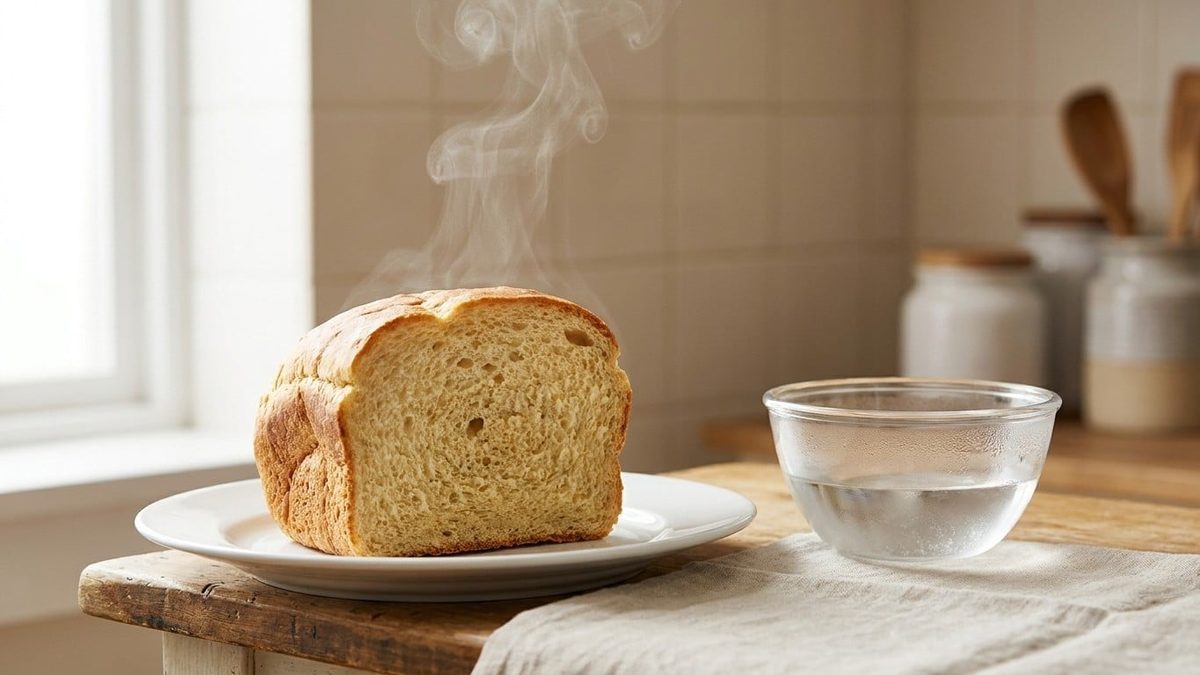
My grandmother never bothered with instruction manuals. When she faced yesterday’s rock-hard crust, she didn’t throw it out. She grabbed a small bowl, filled it with tap water, and set it next to the loaf before popping it in the microwave. I used to think she was warding off a culinary curse. Turns out, she was applying a precise principle of food chemistry without even knowing it.
Stale bread isn’t dry. It’s misorganized.
Twelve seconds with that glass of water is often enough to soften a slice that seemed lost forever. It doesn’t work because the steam rehydrates a dried-out crumb. It works because warm, humid heat restarts a chemical process called starch retrogradation. That is the difference between thinking you are fixing dryness and understanding that you are reorganizing a molecular structure.
Here is what you need to know before you heat up your bread:
- Bread doesn’t dry out when it goes stale; its starch molecules reorganize into crystals.
- Retrogradation is a reversible process: humid heat can temporarily undo it.
- The refrigerator accelerates bread hardening, contrary to popular belief.
Зміст
The Misconception: Bread Isn’t Just Losing Moisture
The myth has legs. We think a hardening loaf is losing water like a sponge left out in the air. But stale bread isn’t necessarily “old” or “expired.” It has simply lost its available moisture due to starch retrogradation. This makes the bread dry, hard, and crumbly within hours or days.
That explanation is too simple.
Bakers and food chemists know the truth: bread doesn’t lose water to become stale. Excess water and low temperatures cause it to harden. The water inside the crumb doesn’t evaporate into the void. It moves. It migrates. It changes molecular owners. It’s a game of musical chairs at the atomic level, not a leak.
What Actually Happens Inside the Crumb, Molecule by Molecule
To understand why the water bowl works, we have to go back to baking. Before heat is applied, starch molecules are organized in crystals linked by hydrogen bonds. Heat and water break those links and replace them with bonds to water molecules. The crystal structure disappears. The starch grains swell. This gives fresh bread its airy, soft crumb.
The problem starts as soon as the bread cools.
As temperature drops, molecules want to attach to each other again to regain a stable crystalline structure. This is retrogradation. Two types of starch molecules are involved, and they don’t work at the same speed.
- Amylose: A straight-chain molecule. It retrogrades quickly during cooling and in the first 24 hours. This gives day-old bread its firmer texture.
- Amylopectin: A branched molecule. It retrogrades much slower over several days. This causes the continuous hardening seen on day two and three.
This is why yesterday’s baguette is still salvageable, but a loaf of sandwich bread forgotten for five days resists revival.
Where does the water go? It doesn’t evaporate instantly. As starch molecules form crystals, they push water molecules out. The water first reaches the crust. That’s why the crust softens when bread goes stale. Only after being expelled outward does the water finally evaporate. Dryness is just a late consequence of an earlier chemical event.
Why the Water Bowl Works (And Its Limits)
Here is the science validating my grandmother’s trick. She wasn’t rehydrating dry bread. She was creating conditions to break the new hydrogen bonds formed between starch molecules.
Retrogradation is thermoreversible. Humid heat can temporarily undo it. Reheating stale bread provides enough thermal energy to break the hydrogen bonds of the crystalline structures. This allows starch molecules to briefly reabsorb the expelled water and regain a pleasant texture.
The bowl of water adds the ambient humidity and steam needed for this reabsorption to happen without drying out the crumb further under the waves.
It’s the same principle behind many anti-waste hacks today: place a glass of water next to bread in the microwave. The released steam helps soften it. My grandmother never read a study on starch gelatinization. She just observed, year after year, that the gesture worked. She passed it on as a kitchen certainty.
There is a limit you must know. This repair is temporary. A few hours after reheating, the bread will go stale again. Sometimes faster than before. The heat-cool cycle restarts a new retrogradation. No surprise, then, that you should use this technique just before eating, never in preparation for tomorrow.
Why Your Fridge Ruins Bread (And the Freezer Saves It)
Most homeowners make a specific mistake with their bakery leftovers. They slide the loaf into the refrigerator. It feels right. It keeps things fresh, right? Wrong.
Here is the science the average cook ignores. Retrogradation is the enemy. This is the process where starch molecules realign and crystallize. At room temperature, it happens slowly. You have time. But inside a fridge? The temperature hovers between 3 and 5 degrees Celsius. That is the sweet spot for bacterial growth and the nightmare for bread structure.
At this specific range, retrogradation accelerates violently. Your bread ages twice as fast in the cold box as it does sitting on the counter. The fridge does not preserve the crumb. It turns soft loaf into a brick.
The Only True Pause Button: Freezing
There is one exception to the rule. One way to stop the clock.
You need sub-zero temperatures.
When you drop below zero degrees Celsius, the retrogradation process stops dead. The starch molecules freeze in place. They cannot realign. The bread does not harden. It just waits.
For anyone buying bread in bulk, this is the only viable storage method for anything beyond 24 hours. The freezer is not a backup plan. It is the only mechanism that halts the mechanical aging of starch.
Store your sourdough or baguettes in heavy-duty freezer bags. Remove the air. Squeeze it out. Label the date. When you are ready to eat, let it thaw at room temperature or toast it directly from frozen. Do not refreeze.
The fridge is a trap. Trust the frost.