Most homeowners assume their heat pump is just an electric heater with a fan attached. It’s not. It’s a heat mover.
In winter, it pulls warmth from the cold air outside and dumps it inside. In summer, it does the reverse. It removes heat from your home and vents it outdoors. No fuel combustion. No glowing red heating elements. Just physics.
The cycle relies on refrigerant. A liquid absorbs heat as it turns into a gas. It releases heat as it cond back into a liquid. This is the same principle your refrigerator uses. But scaled up for your whole house.
Зміст
The Mechanics of Cooling and Heating
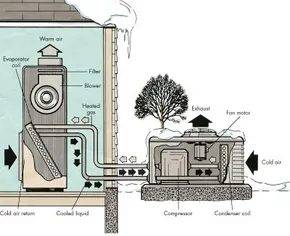
During summer months, the system acts like a standard central air conditioner. Refrigerant flows through evaporator coils inside. As it expands, it changes state to gas. It pulls heat from the indoor air.
A blower pushes that cooled air through your ducts. The now-warm gas moves to a compressor. It gets squeezed. Pressure rises. Temperature spikes. The gas travels outside to the condenser coil. Here, it releases its stored heat into the atmosphere. It returns to a liquid. The cycle restarts.
Winter flips the script. A reversing valve changes the flow direction. Now, the outdoor coil acts as the evaporator. It extracts whatever heat remains in the outside air. Even at freezing temperatures, there is thermal energy to be had. The indoor unit releases that heat into your living space.
Efficiency drops as temperatures fall. The sweet spot is around 45°F to 50°F. Below that, the pump struggles. It has to work harder to pull heat from thinner, colder air.
When the mercury dips below freezing, efficiency plummets. This is when auxiliary electric heaters kick in. These resistive heaters are expensive to run. They can make your utility bill spike. If you live in a climate where winter temperatures stay below freezing for long stretches, a heat pump may not be practical. You might spend more on electricity than you would saving on fuel. In hot, humid climates, however, the heat pump shines. It handles cooling and heating with equal grace.
Why Maintenance Matters More Than You Think
A heat pump runs twice as hard as a standard furnace. It operates year-round. This means small issues become big problems faster.
Neglecting minor repairs can lead to catastrophic compressor failure. Compressors are expensive. They are the heart of the system. If the heart stops, the house is uncomfortable.
Because heat pumps are more complex than basic heating systems, major repairs require a professional. You need a technician who understands refrigerant pressures and electrical components. But you can prevent many of these issues yourself.
Dirty filters restrict airflow. Restricted airflow starves the coils. Starved coils freeze up. Frozen coils break the cycle. Change your filters regularly. Keep the area around indoor vents clear of furniture or rugs. Air needs to flow freely.
Outdoor Unit Care: Keeping the Heart Pumping
The outdoor unit contains the compressor, coil, and fan. It sits exposed to the elements. Leaves, pine needles, and dirt accumulate. This debris blocks airflow. Blocked airflow reduces efficiency. Reduced efficiency increases wear.
Before cleaning, shut off power to the unit. Safety first. Never reach into a fan blade with power on.
Remove the protective grille. It’s usually held by retaining screws. Clear out leaves and dirt from the updraft fan. Use a vacuum hose to suck debris from between the fan blades. Be gentle. The fins are thin and bend easily. Bent fins restrict air.
Check the level of the unit. Place a carpenter’s level across the top of the metal cabinet. Check side-to-side and front-to-back. An unlevel unit vibrates. Vibration causes fatigue. Fatigue leads to cracks.
If the unit is tilted, lift the concrete pad. Use a pry bar or a sturdy 2×4 to adjust it. Add stone or crushed rock underneath to stabilize and level it. A solid foundation prevents future settling.
Inspect the piping insulation. This foam or rubber wrap covers the refrigerant lines. If it’s cracked, torn, or missing, replace it. You can buy replacement insulation at most heating supply stores. Follow the manufacturer’s instructions. Proper insulation keeps the refrigerant at the right temperature. It also prevents condensation drip.
Handling Power Interruptions
A power outage happens. The breaker trips. The fuse blows. The utility cuts power.
If your heat pump has been off for more than an hour, do not turn it back on immediately. Especially if it’s 50°F or lower outside.
The oil in the compressor’s reservoir needs time to warm up. Cold oil is thick. It doesn’t circulate properly. If you force the compressor to run with cold, thick oil, you can damage the valves. Valve damage means a new compressor.
Instead, set the thermostat to “Emergency Heat” or “Aux Heat.” This bypasses the heat pump cycle. It keeps the system off. It lets the oil warm to operating temperature naturally.
Wait six to eight hours. Then switch the system back to its normal heating setting.
Monitor the output. If the system blows cool air or no heat at all, call a professional. Do not keep cycling it on and off. You could cause further damage.
The Reality of Heat Pump Ownership
Heat pumps are efficient when the climate cooperates. They are not magic. They are mechanical systems subject to wear and tear.
They require attention. Regular filter changes. Clean outdoor coils. Level foundations. Proper insulation. These are not optional. They are the difference between a system that lasts fifteen years and one that fails in five.
You don’t need to be an engineer to maintain a heat pump. You just need to be consistent. Watch for dirt. Listen for unusual noises. Check the level. Respect the power interruptions.
The system works for you. It’s worth working for it.